Log monitoring plays a critical role in incident response, yet many teams overlook its potential. Streamlining log integration can significantly improve resolution times.
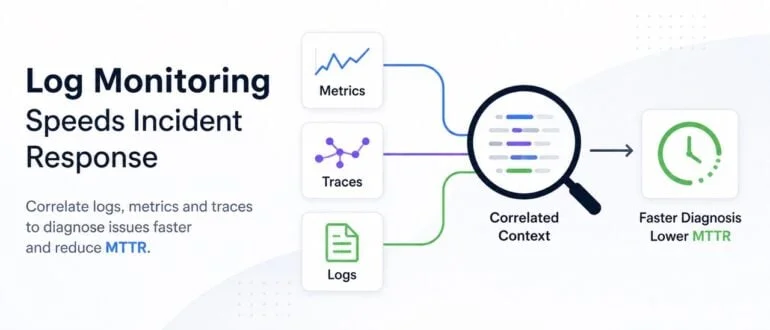
Engineering teams are heavily invested in observability, yet many still see slow resolution times during incidents. Despite having tools like dashboards and alerts in place, the bottleneck often lies in how logs are utilized within the broader incident response process. More precisely, it's about integrating log data effectively into workflows rather than simply hoarding it.
The Disconnect of Multiple Tools
In a common incident scenario, an alert signals a problem, prompting an on-call engineer to juggle three separate applications: a metrics dashboard to gauge the scope of the issue, a logging interface to pinpoint the root cause, and a tracing tool to track the request path. This fragmented process not only delays diagnosis but also extends the time taken to resolve the incident. A recent survey of IT and DevOps leaders reveals that almost one-third of organizations utilize five or more observability tools, and a staggering two-thirds report that it takes at least four hours to resolve production issues—a clear sign that too many tools can complicate rather than clarify.
The Narrative Importance of Logs
Logs serve a dual purpose in incident response—they’re not just diagnostic tools; they tell the story of what transpired leading up to, during, and after an incident. While metrics can indicate that something's wrong and traces can reveal failure points in the system, logs provide the crucial narrative context essential for effective triage. Unfortunately, they’re often relegated to after-the-fact analysis during postmortems rather than being actively utilized to address ongoing incidents. Shifting this approach and ensuring that log data is readily accessible during incidents can substantially enhance a team’s response capability.
Best Practices for Log Integration
Improving how logs are integrated into incident response involves embracing three core practices:
- Correlate logs at the alerting stage: When an alert is triggered, relevant log events should be automatically surfaced within the response interface. This approach saves engineers from the unnecessary pressure of switching tools and constructing queries from memory when time is of the essence.
- Standardize structured logging: Unstructured logs hinder quick access under stress. Organizations that have adopted structured logging—using consistent field names, log levels, service identifiers, and request IDs—find it significantly easier to search and act on relevant information swiftly.
- Choose the right logging tools: The right monitoring tools should be capable of handling the volume and speed of log data generated in real time. A delayed logging platform won't serve engineers well when every second counts during a major incident.
Impact on the On-Call Experience
The experience of on-call engineers can greatly suffer if log monitoring practices are ineffective. While alert fatigue is a known concern, "log fatigue"—the overwhelming feeling of sifting through unstructured log data—can also impede performance. By presenting well-structured logs, correlated with relevant metrics and traces, the on-call task transforms into a manageable cognitive challenge instead of an exhausting hunt for answers. The decision to enhance log monitoring doesn't only affect observability strategy; it reverberates through the health of the organization itself.
The Role of OpenTelemetry
OpenTelemetry's growing adoption marks a significant shift in how teams manage log integration. As its logging specification develops, it provides a standardized method to collect and manage logs alongside traces and metrics. This advancement is crucial for incident response because it fosters a coherent environment where logs carry identifiable trace IDs, allowing engineers to navigate between different types of data fluidly during high-pressure situations.
Expediting the Incident Response Cycle
Incident response maturity is frequently gauged by metrics like Mean Time to Resolution (MTTR), a metric that reflects downstream performance. However, true improvements stem from upstream elements such as time to detection, time to context, and time to diagnosis—all of which can be significantly compressed through effective log monitoring. Teams that excel in reliability don’t just prioritize alerts or granular metrics; they elevate log data to a primary status within their workflows, ensuring it plays an active role in real-time analysis rather than serving as a fallback for later examination.
In an era where system downtimes carry quantifiable financial repercussions, the need to reduce the lag between detection and understanding becomes critical. Optimizing log monitoring can effectively bridge that gap, making it an indispensable practice for any organization aiming to enhance its incident response capabilities.
Discussion
Sign in to join the discussion.