Tricentis's acquisition of Tabnine aims to integrate an advanced knowledge graph into its testing platform, enhancing AI's role in code verification.
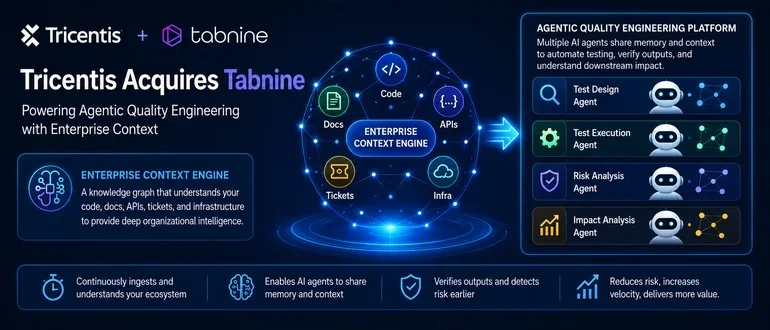
Tricentis has announced its acquisition of Tabnine, a move aimed at enhancing AI capabilities within software testing tasks. By integrating Tabnine's knowledge graph, known as the Enterprise Context Engine, into Tricentis's Agentic Quality Engineering Platform, the company is positioning itself to dramatically improve its understanding of code and the testing requirements associated with it. This acquisition signals a larger trend within the tech industry: the drive to automate not just coding, but also the testing processes that ensure software quality.
Leveraging the Knowledge Graph
The integration of the Enterprise Context Engine alongside a vector model allows AI to gather and analyze crucial data from various sources. These include repositories, documentation, tickets, APIs, and infrastructure metadata. Such a consolidated data framework empowers AI agents to better navigate programming contexts and uncover relationships and architectural patterns that may not be immediately obvious. This can reduce the chances of misinterpretation, which can lead to costly errors in production.
What's particularly interesting about this development is the emphasis on collaboration among multiple AI agents. These AI agents won't just process data in isolation; they'll share context and memory with each other, which is vital for verifying outputs and understanding the broader ramifications of their actions. This collaborative approach marks a shift in how we think about AI in software development—not just as tools that run tasks, but as entities capable of engaging in complex decision-making processes.
Efficiency in Code Testing
David Colwell, Tricentis's VP of AI and machine learning, has pointed out that this advancement will enable AI agents to conduct code testing more efficiently. You'll see a reduction in the total number of tokens needed during these processes, which raises the question: why does this matter? Fewer tokens generally mean quicker computations and lower costs, particularly when scaling these solutions across enterprises. The faster the processes, the less burden there is on resources during peak development periods.
This shift is critically important. We're still in the nascent stages of incorporating AI agents into DevOps workflows. Yet, the need for independent AI agents to validate the outputs produced by coding agents is becoming increasingly apparent. Testing should ideally use distinct models compared to those employed for coding. The risk of overlap is too significant; inefficient processes could arise if one model is used for both tasks. This transition to specialized models may require additional investments but brings a clear advantage in reducing errors and improving testing outcomes.
The Risks of Untested Code
If AI agents aren't embedded into the testing workflows, DevOps teams might find themselves struggling to keep pace with the speed of code production. The consequences are palpable: a growing influx of untested code makes its way into production environments, amplifying the workload for teams later responsible for triaging and addressing such issues. These environments risk becoming chaotic, leading to frustration among developers and potentially harming customer trust if issues go unresolved.
A survey from Tricentis reveals some alarming trends: about 60% of companies are currently deploying untested code into production. This statistic underscores a critical challenge faced by organizations today. While approximately 68% of firms have started using some form of AI in their software delivery processes, a fundamental question remains: how can they balance the efficiency of development with the imperative to minimize untested code?
The Value of Speed vs. Quality
There's a common misconception that speed in code delivery directly translates into greater business value. However, this assumption comes with significant pitfalls. Every incident of untested code can lead to a drop in the return on investment tied to quick software delivery. As the volume of code produced continues to outstrip the management capabilities of most DevOps teams, organizations face an ongoing tension between the pace of development and maintaining high-quality standards.
What this means for you, if you're working in this space, is that embracing AI for testing is not just about keeping up with trends; it's about future-proofing your development processes. The narrative is shifting toward a model that emphasizes quality as much as, if not more than, speed. Those who can successfully implement AI testing solutions will likely gain a competitive edge in an increasingly crowded marketplace.
Future Implications of AI in Testing
The implications of these advancements are profound. As AI continues to evolve, the quality of outputs in software development will rely heavily on the systems engineered to manage complexities. Companies that fail to adapt risk stagnation. The future of AI in testing could redefine quality assurance by integrating real-time analytics, predictive capabilities, and automated responses into everyday workflows.
Tricentis's move to incorporate Tabnine's knowledge graph represents a significant step in that direction. It’s an acknowledgment that the future of software development hinges on collaboration—not just between humans, but between AI agents themselves. As organizations navigate an increasingly complex digital landscape, embracing these tools could become not just beneficial, but essential.
Discussion
Sign in to join the discussion.