The ongoing regulatory battle over prediction markets highlights the clash between federal oversight and state gambling laws, with significant lobbying efforts involved.
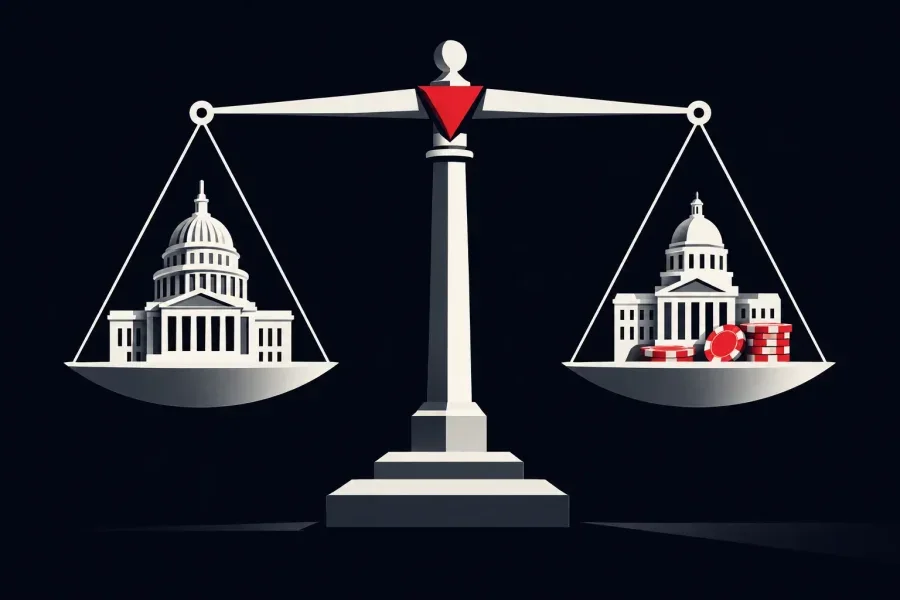
As the market for prediction platforms expands rapidly, the debate over regulatory authority intensifies. Companies like Kalshi and Polymarket argue that their contracts should be federally overseen, while states maintain these fall under gambling laws they govern. This dispute has resulted in expenditures exceeding $3 million on lobbying and political contributions in 2026.
The CFTC’s legal actions against certain states aim to uphold federal oversight of prediction markets, underscoring a critical tension. Various state officials are pushing back, emphasizing their jurisdiction over these platforms, which they liken to casinos rather than traditional financial instruments.
Kalshi's Influence Grows
Kalshi’s lobbying efforts have been substantial, with over $620,000 directed towards various political associations in the first half of 2026 alone. Among its contributions, Kalshi allocated $147,500 to the Republican Attorneys General Association and $170,000 to their Democratic counterpart. This strategic investment not only demonstrates an effort to curry favor with legal power brokers but also highlights the company's intent to ensure its voice is heard across the political spectrum. These bipartisan contributions reflect a keen awareness that regulatory outcomes could swing unpredictably.
In states like California and New York, Kalshi has spent significantly, projecting over $400,000 in New York through in-house and external lobbyists. The investment in California totaled $62,000, a move that illustrates a targeted approach in states where regulatory decisions could be pivotal. The nearly $1 million spent on federal lobbying by midyear is indicative of Kalshi's serious commitment to influencing regulations that could determine its future. If you're working in this space, you know that such investments drive the narrative in policy discussions, and Kalshi appears well-aware of this tactic.
Kalshi’s co-founders have supported candidates from both major parties, contributing about $1 million throughout the election cycle. This bipartisan approach could be strategically aimed at appeasing state attorneys general, who are essential to the ongoing legal battles. The practice of engaging with both sides of the aisle not only broadens Kalshi's influence but also helps hedge against shifts in political wind, creating a buffer that could be valuable in unpredictable regulatory climates.
Continuing Regulatory Conflict
The crux of the matter remains whether federal regulation can supersede state laws that govern gambling activities. A letter signed by 44 state attorneys general in July expressing opposition to federal preemption has amplified the tension. They collectively characterized prediction markets as an evolution of casino-like products, raising questions about their regulation. This resistive stance from state officials underscores their desire to maintain a grip on the regulatory reigns, particularly in a landscape that is already muddied by differing interpretations of what constitutes gambling.
Currently, various lawsuits are venturing through federal courts, and judges demonstrate varied interpretations. This inconsistency leaves confusion in the regulatory framework. Predictably, this ongoing saga echoes a growing interest in how jurisdictions will manage prediction markets amid expanding consumer engagement. Those keeping an eye on this area should brace for a regulatory environment likely to remain contentious, unpredictable, and fraught with legal precedent-setting implications.
Kalshi, along with other industry players, has aligned to advocate for clearer regulatory guidance through the Coalition for Prediction Markets, founded in December 2025. This coalition represents a unified front aimed at tackling the regulatory ambiguity that often stifles innovation and investment in prediction markets. Notably, Polymarket is absent from this coalition but is similarly responding to heightened scrutiny. Their absence raises questions about whether this could be a strategic misalignment, with Polymarket potentially missing out on collaborative lobbying opportunities that are essential in influencing policy discussions.
Future of Regulation Remains Uncertain
As the legal disputes continue, Kalshi’s strategic lobbying in key states may serve as a critical lifeline should courts affirm that prediction markets fall under state gambling regulations. If state-level regulation triumphs, companies like Kalshi might need to pivot their strategies to align with the more localized, potentially fragmented regulatory environment. Meanwhile, Polymarket has not yet secured registered lobbyists in these contested states, potentially placing it at a disadvantage. It raises an important question: can a lack of lobbying in critical states weaken Polymarket's standing as regulatory battle lines are drawn?
While this regulatory tug-of-war is being scrutinized in federal courts, the ultimate resolution regarding the jurisdictional dispute remains elusive. State officials are actively pursuing their case in policy debates and legal frameworks while prediction companies maintain their lobbying efforts. The contest isn't simply about contracts but the fundamental question of how these platforms will be treated under law. The stakes are high; will federal authorities maintain their ground, or will states reclaim their regulatory oversight over prediction markets?
Implications for the Sector
The significance of these legal tussles can't be overstated. Prediction markets could transform how information is traded and utilized if federal regulation prevails. They could be integrated into financial portfolios and bolster forecasting models across industries. Conversely, if states assert greater control, it could create a patchwork of regulations that stifles innovation and complicates operations for market players. And this is the part most people overlook: the wider economic impacts of such regulatory frameworks go beyond individual businesses; they could shape entire sectors of the economy.
What does this mean for consumers and businesses? If you're a business considering entering prediction markets, the regulatory landscape must be a part of your strategic calculus. Companies need to be ready for rapid pivots based on judicial outcomes, as the dynamics shift day by day. The path ahead remains unclear, but one thing is likely: the evolution of prediction markets will continue to draw scrutiny and debate, fundamentally altering both the technology involved and how society perceives risk and reward.
Discussion
Sign in to join the discussion.